Pioneering the Energy Future of India and the Role of SMRs in Sustainable Development
Presently, India, with a population of over 1.4 billion people, is the world’s fifth-largest economy. To meet the needs of society and industry, the country faces a growing energy crisis. The enormous demand for energy production must be balanced with environmental sustainability. The current energy mix includes coal, natural gas, hydro, nuclear power, and increasing contributions from renewable sources such as wind and solar energy. Policymakers must ensure that this energy mix remains both affordable and sustainable.
The Union Budget 2024 presents a clear strategy to address India’s growing energy challenges. A major focus is the development of Small Modular Reactors (SMRs). These reactors can help meet rising energy demand while supporting environmental sustainability. The budget highlights research and development in Bharat SMRs and encourages collaboration between public and private sectors for their deployment in the national energy mix. This initiative aligns with India’s vision of becoming a developed nation under Viksit Bharat.
The budget also promotes rooftop solar power through the PM Surya Ghar Muft Bijli Yojana and supports pumped storage systems to strengthen renewable energy integration. In addition, Advanced Ultra Super Critical (AUSC) thermal power plants are proposed to improve efficiency and support economic growth. This article discusses India’s energy needs, the role of nuclear power, key policy initiatives, and the strategic vision for 2047. It also outlines important action plans required for a sustainable and secure energy future.
At present, India is among the largest energy consumers in the world. The country’s economy is driven by industrial growth, rapid urbanization, and improving living standards. In recent years, renewable energy deployment has expanded significantly. However, coal-fired thermal power plants still dominate electricity generation. Coal accounts for nearly 65% of India’s total electricity production (Figure 1). This heavy dependence on fossil fuels creates serious environmental concerns. High CO₂ emissions and other harmful gases contribute to air pollution. These emissions affect public health, accelerate climate change, and contribute to the global rise in temperature.

Figure 2, interestingly illustrates the concept of measuring the carbon footprint. The image shows a large footprint marked with “CO₂,” symbolizing carbon emissions. Individuals are depicted using measuring tools, representing the process of assessing these emissions. The presence of green plants highlights the environmental context and emphasizes the need to reduce carbon emissions to protect the environment.

The Government of India has launched several programmes to promote solar energy. The Rooftop Solar Scheme encourages the installation of solar panels on rooftops to reduce dependence on conventional energy sources. The National Solar Mission (NSM) supports the expansion of solar power and sustainable development. The Pradhan Mantri Kisan Urja Suraksha evam Utthaan Mahabhiyan (PM-KUSUM) improves energy access and water security in rural areas through solar-powered systems. The Canal Solar Power Project (CSPP) installs solar panels over canals to generate renewable energy without using agricultural land.
The PM Suryoday Yojana 2024 aims to reduce electricity expenses by promoting rooftop solar installations. Under this initiative, subsidies are proposed for solar installations in one million households across the country. The Production Linked Incentive (PLI) Scheme, with a budget of about ₹24,000 crore, supports domestic manufacturing of high-efficiency solar photovoltaic (PV) cells.
The Role of Nuclear Energy
The Government of India has made strong efforts and set ambitious targets to diversify its energy mix and reduce carbon emissions. These efforts include increasing the share of renewable energy, improving energy efficiency, and expanding the role of nuclear power. Nuclear energy is viewed as a key component of India’s strategy to ensure a stable and low-carbon energy supply.
India’s nuclear energy programme was initiated under the leadership of Dr. Homi J. Bhabha. At present, 24 operational nuclear reactors generate about 8,780 MW of electricity. Figure 3, shows the geographical distribution of nuclear power plants across the country. The installed nuclear capacity is expected to increase from 8,780 MW to about 21,980 MW by 2031–32, as projects under construction and approved facilities are completed. The government has also granted in-principle approval for new reactor sites. These developments position India to significantly expand its nuclear capacity. This will help to meet growing energy demands and reduce dependence on fossil fuels.
However, large nuclear reactors often face challenges such as high capital costs, long construction periods, and public concerns about safety. In this context, Small Modular Reactors (SMRs) have emerged as a promising solution to address these limitations.

The Prototype Fast Breeder Reactor (PFBR) at Kalpakkam, Tamil Nadu, has received approval for nuclear fuel loading after safety clearance from the Atomic Energy Regulatory Board (AERB). This marks an important milestone in India’s atomic energy programme. The 500 MWe sodium-cooled reactor uses plutonium-based fuel and is designed to eventually utilize thorium-232. India possesses limited uranium resources but abundant thorium reserves, making breeder technology crucial for long-term energy security.
The PFBR was developed over two decades and was largely designed and constructed in India with participation from more than 200 industries. Initially, the reactor will operate using Uranium–Plutonium Mixed Oxide (MOx) fuel before transitioning to thorium-based fuel cycles. Prime Minister Narendra Modi visited the facility in March 2024, accelerating progress toward its final operational stage. The reactor incorporates advanced safety systems and is expected to improve fuel utilization while reducing nuclear waste. With this development, India joins a select group of nations, including Russia, operating fast breeder reactor technology.
This achievement complements the Union Budget 2024 emphasis on Small Modular Reactors (SMRs). The PFBR provides technological experience that can support future advanced reactor programmes, including additional breeder reactors at Kalpakkam. The budget also highlights the growing role of SMRs within India’s long-term energy strategy. These initiatives align with the Viksit Bharat@2047 vision of transforming India into a developed nation by the centenary of its independence. The strategy encourages collaboration with private industry for SMR development, reflecting an evolving national energy policy.

Small Modular Reactors (SMRs) offer several advantages for India’s energy needs. They typically generate between 50 MW and 300 MW of electricity. These reactors are much smaller than conventional nuclear power plants (see Figure 4), making them flexible and easier to deploy. Their modular design allows transportation by ship, truck, or rail, enabling efficient distribution of energy infrastructure across the country.
SMRs can also be installed in multiple modules, allowing electricity generation to be expanded as demand grows. This feature makes them well suited to meet fluctuating energy requirements. Their compact size and factory-based modular construction reduce initial investment costs and shorten construction time. The Figure 5, illustrates how different modules can be combined to form a typical SMR system.
Advanced fuel designs and higher fuel efficiency help reduce the generation of high-level radioactive waste. These characteristics make SMRs particularly suitable for India, including deployment in remote and underserved regions. The International Atomic Energy Agency (IAEA) supports SMR development by assisting countries in technology adoption and infrastructure planning, with the goal of making SMRs reliable and economically competitive.
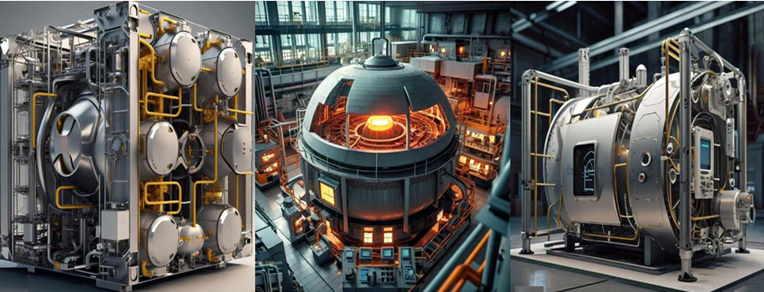
The 2018 SMRs Regulators’ Forum Pilot Project (RFPP) report highlights growing global interest in Small Modular Reactors (SMRs) as a pathway toward sustainable and secure energy systems. SMRs are considered important both for expanding existing nuclear programmes and for countries initiating new ones. The International Atomic Energy Agency (IAEA) actively supports SMR development through technical projects and publications. The RFPP report, based on a series of international meetings, identified key regulatory challenges associated with SMRs and provides guidance for future regulatory frameworks.
By 2022, small modular reactors had become operational in Russia, China, and India. Several additional SMRs are under construction, while more than 60 designs are currently under development worldwide. Most proposed reactors fall within the 50–300 MW power range. In India, the Bhabha Atomic Research Centre (BARC), Mumbai, initiated SMR development as part of the country’s efforts to advance safe and efficient nuclear technologies.
The Government of India has undertaken major initiatives to promote SMR deployment, including collaboration with private industry. Such partnerships combine the strengths of public institutions and private enterprises to accelerate advanced nuclear technology development. Current efforts emphasize research and development aimed at improving safety, efficiency, and system reliability. Plans also include integrating SMRs with larger Pressurized Heavy Water Reactors (PHWRs), which could significantly increase national nuclear power capacity. This integrated approach is expected to strengthen India’s nuclear energy infrastructure while contributing to long-term energy security and sustainability goals.
Government Policies and Initiatives
India is also strengthening its commitment to Small Modular Reactors (SMRs), industrial decarbonization, and improved energy efficiency across the economy. The Union Budget 2024–25 reflects a comprehensive strategy in this direction. A key proposal is the development of a climate finance taxonomy. Such a framework will help channel investments toward climate-friendly activities and ensure the availability of funds for mitigation efforts. It will guide financial institutions in supporting sustainable and energy-efficient projects. Through these measures, India aims to reduce carbon emissions, enhance energy efficiency, and accelerate the transition toward a greener and more resilient economy.
Complementary Energy Projects
Complementary energy initiatives are advancing alongside this strategy. The Government of India is promoting Pumped Energy Storage Projects (PESP) to support large-scale integration of renewable energy and strengthen grid stability. These systems generate electricity by circulating water between reservoirs at different elevations, enabling reliable storage and controlled dispatch of renewable power.
At the same time, efforts are underway to improve the efficiency of coal-based power generation. The government is supporting Advanced Ultra Super Critical (AUSC) technology to enhance thermal power plant performance and reduce emissions per unit of electricity produced. A major step in this direction is a joint venture between the National Thermal Power Corporation (NTPC) and Bharat Heavy Electricals Limited (BHEL) to build an 800-MW thermal power plant based on AUSC technology.
Together, these initiatives aim to create a balanced, efficient, and resilient energy infrastructure capable of meeting growing energy demands while supporting climate goals.
Strategic Vision for 2047
India plans to expand its nuclear power capacity through both Small Modular Reactors (SMRs) and large conventional reactors. This effort forms part of the Viksit Bharat 2047 vision, which aims to transform India into a developed nation by the centenary year of independence. The programme places strong emphasis on empowering youth, reducing poverty, strengthening the role of women, and supporting farmers. At the same time this ensurs reliable and clean energy for long-term national growth.

By integrating advanced nuclear technologies with other energy initiatives, the government aims to build a diverse and sustainable energy mix. This vision emphasizes innovation and collaboration to ensure long-term energy security and economic growth.
Action Points for Realizing Energy Goals
To realize the full potential of SMRs and other energy projects, the Indian government has identified several key action points. Public–private partnerships are essential in this effort. By combining the expertise and resources of both sectors, the government aims to accelerate the adoption and deployment of advanced nuclear technologies and meet energy demands more efficiently.
Investment in research and development (R&D) remains a priority. It is vital for advancing nuclear technologies and maintaining high safety standards. R&D can provide innovative solutions to address present and future energy challenges.
Policy development and financial planning are also important to support climate-friendly and energy-efficient projects. The government plans to create a climate finance taxonomy to ensure effective allocation of resources, as proposed in the budget speech of the finance minister.
There is also a need to integrate renewable energy sources with conventional power generation. This approach will help create a sustainable energy infrastructure, ensure a balanced energy mix, and strengthen long-term energy security.
Public Awareness and Education
At present, nuclear power plants operate under strict regulatory provisions. The technical and commercial aspects of SMRs are still at an early stage worldwide. Large-scale deployment of SMRs will depend on regulatory harmonization led by the International Atomic Energy Agency (IAEA), particularly in areas such as emergency planning zones and public acceptance.

Public awareness about the significant advantages of nuclear energy must be increased on a large scale (Figure 7). Radioisotopes produced in reactors play vital roles in medical diagnostics and treatment, industrial applications, agriculture, and scientific research. Educating people about these benefits can improve public acceptance and support for nuclear energy. India needs to strengthen nuclear physics education and launch nationwide awareness campaigns. These campaigns should highlight the benefits of nuclear energy while addressing safety concerns and removing common myths. Such initiatives should also be incorporated into the National Education Policy.
Historically important universities with strong foundations in nuclear physics teaching and research should be encouraged by the government to promote nuclear energy awareness. Special programs and outreach activities, particularly for undergraduate students, can play a major role in public education. These institutions can help reduce misconceptions and emphasize the wide applications and benefits of nuclear technology.
Conclusion
India’s focus on SMRs, along with complementary energy initiatives, positions the country to meet future energy demands sustainably and efficiently. The government is emphasizing innovation, collaboration, and decarbonization. The SMR initiative forms part of a comprehensive strategy to transform the nation’s energy landscape, aligned with the vision of Homi Bhabha. By integrating advanced nuclear technologies with renewable energy and improving energy efficiency, India aims to achieve a developed and decarbonized economy by 2047. This multifaceted approach can provide reliable, affordable, and clean energy while contributing to global climate and sustainable development goals.
***

Professor B. P. Singh is an experimental nuclear physicist, former Chairperson, and presently a Senior Professor in the Department of Physics, Aligarh Muslim University, Aligarh, Uttar Pradesh, India.


Comments