Constructing and Working of a Spark Counter: A Simple Yet Powerful Tool for Alpha Particle Detection
Introduction
The spark counter is a classic yet visually striking detector used in nuclear physics to observe ionizing radiation. It was first explored in the 1940s. This device provides a direct and fascinating way to detect alpha particles through visible sparks produced in air. Unlike conventional detectors that require thin windows, the spark counter operates in a windowless configuration. This makes it especially suitable for detecting alpha particles with very short ranges.
At the Nuclear Physics Lab, of the Department of Physics, Aligarh Muslim University, a compact spark counter has been developed. This spark counter demonstrates the alpha particle detection. This is also used to measure range of alpha particles in air, and to study ionization processes in air. This setup serves as an excellent experimental tool for both teaching and introductory research.
Construction of the Spark Counter
The entire Spark Counter was fabricated inhouse using the workshop facility. The detector consists of a carefully designed electrode system and supporting structure to ensure stable operation and precise measurements.
Two aluminum plates (7 cm× 7 cm, 5 mm thick) are arranged perpendicular to each other.
The edges of the plates are rounded to minimize corona discharge.
A thin tungsten wire is stretched parallel to the plate and acts as the anode.
The entire assembly is mounted on a Perspex base and enclosed in a transparent Perspex chamber.
A movable α-source (241-Am) is positioned using a medical syringe-based (for finer movement) mechanism for controlled displacement.


The wire to plate separation is adjustable using an attached screw gauge mechanism. This allows fine control of the electric field strength.
Working Principle
The spark counter operates on the principle of ionization followed by avalanche multiplication:
A high voltage is applied using an old power supply(1–5 kV), between the plate (cathode) and the wire (anode).
When an alpha particle passes through the air between them, it ionizes the air molecules.
The strong electric field accelerates these charges, producing an avalanche of electrons.
This results in a visible spark, indicating the detection of an alpha particle.

Initial Observations
During testing:
The sparks were clearly observed when the source was placed at a distance of about 3–4 cm from the wire.
Introducing a sheet of paper between the source and wire completely stopped the sparks, confirming that the signals were due to alpha particles.
The detector showed directional sensitivity. It was found to respond only to aalpha particles incident within a narrow angular range.


Measurements and Results
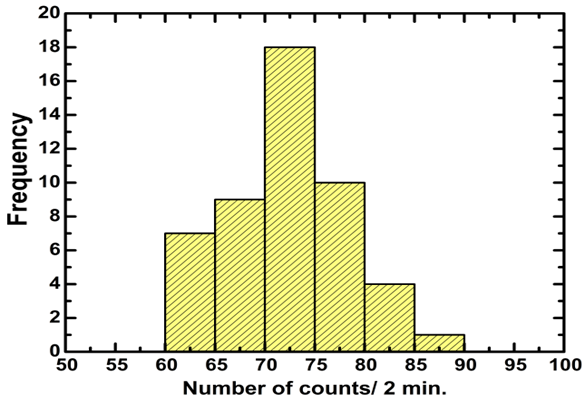
Count Distribution
Counts recorded from the 241-Am source showed a distribution consistent with radioactive decay statistics.
Count Rate vs Distance
The variation of count rate with distance was studied at different voltages (3.0, 3.25, and 3.5 kV):
Count rate initially increases as the source approaches the wire.
It stabilizes at intermediate distances.
At very close distances, count rate decreases due to reduced ionization efficiency.

Bragg Curve Analysis
To account for geometrical effects, the quantity Nd² was plotted against distance:
The corrected plots reveal a Bragg peak, characteristic of alpha particle energy loss.
Maximum ionization occurs near the end of the particle range.

Range and Energy Determination
The measured range of alpha particles in air was found to be:
≈ 3.7 – 3.8 cm
Corresponding energy estimates:
≈ 5.3 – 5.4 MeV
These values are in close agreement with standard data for 241-Am, demonstrating the accuracy of the spark counter.
Key Observations/Insights
As expected the spark counter is found to be highly sensitive to alpha particles in air.
Exhibits directional detection properties.
Successfully reproduces Bragg curve behavior.
Allows estimation of alpha particle range and energy using simple experimental techniques.
Conclusion
The constructed spark counter demonstrates that a relatively simple setup can provide deep insights into nuclear physics. Its ability to visually display ionizing events, measure particle range, and confirm theoretical predictions makes it an invaluable educational and experimental tool. This experiment highlights how fundamental principles of ionization and electric fields can be used to detect and study radiation in a direct and engaging manner.
For Atomic Explorers
This work reflects the spirit of Atomic Explorers-bringing complex nuclear physics concepts into accessible, hands-on experimentation. The spark counter stands as a powerful reminder that even simple instruments can reveal profound aspects of the microscopic world.
I thank Dr. Mohd. Shuaib, Dr. Vijay R. Sharma, Dr. Shariq Asnain, and Mr. Aquib Siddiq for all the efforts in making this counter from scratch.


Comments